Natural Enemies Team
Entomophagous fungi are parasitic on insects. Up to this time, 17 species of fungi have been separated from 70 species of insect cadavers in Southeast Asia and South America. A fungus, separated from a chrysomelid beetle collected from Indonesia, showed strong infectivity to P. xylostella, and is one of the new microbial control agents for P. xylostella. In addition, there have been some other pathogen fungi which have promising potential for microbial control agents. These fungi are being investigated for their infectivity to certain insects and on their effectiveness as biological pesticide in field experiments.
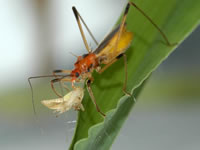
Some assassin bugs, such as Plytoxus selangorensis and Polididus perarmatus, are considered as possible biological control agents for some insect pest of paddy fields. On the other hand, some wasps, such as Diadegma semiclausum and Cotesia plutellae, are considered to be possible biological control agents for Plutella xylostella and Crocidolomia binotalis which are important insect pests of vegetables. Therefore, mass production methods of these natural enemies are being facilitated for practical use, which is the teams main objective.
In Phase II, this team aims (1) To search for indigenous natural enemies of insect pests and determine its effectiveness; (2) To investigate the mass production of pathogenicity microorganisms including entomophagous fungi; (3) To establish the mass production methods of some natural enemies of insect pests; (4) To develop new control methods using bioactive substances (e.g. pheromones); and (5) To develop new control methods using certain natural enemies.
 |
 |
 |
|
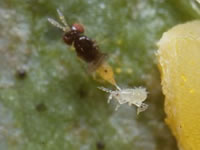
Thrips parasitoid, Ceranisus menes |
Assassin bug attacking a leafhopper |
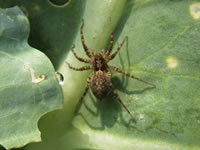
Utilization of predatory spiders |
 |
 |
|
|
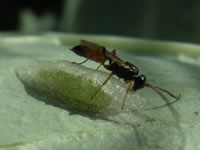
Utilization of larval parasites |
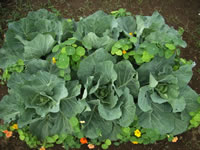
Mixed cropping of cabbage and herb |
|

|








 1.Introduction

 トップページ > WEBジャーナル>学術フロンティア共同研究

